Sectional Barge Bridge Repair · Summer 2026
Summer 2026 Bridge Repair Season: Configuring a Sectional Barge for High-Water Access
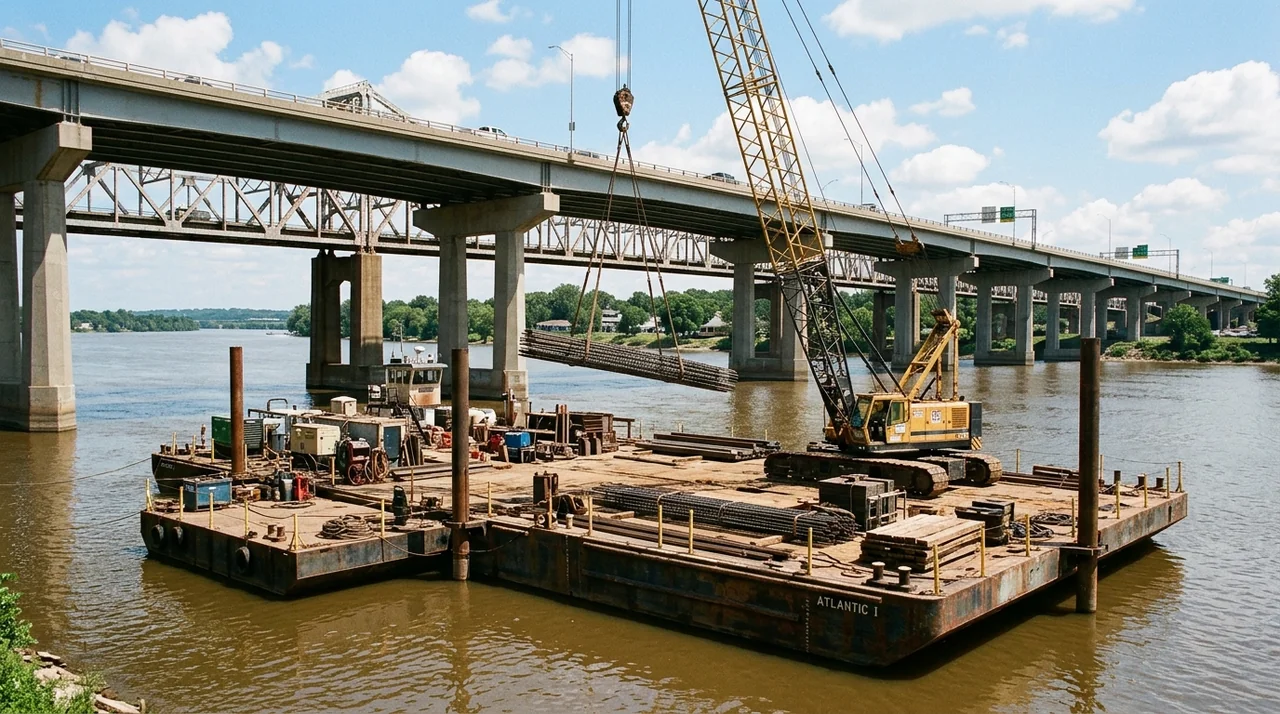
Sectional barge bridge repair, a working view.
Bridge repair season in the United States peaks between June and September, when high water and warm weather give crews the biggest work window. In 2026 the demand has only grown, with federal infrastructure funding still flowing into bridge deck replacements, pier repairs, and scour repairs across the country. This is Work Marine’s field guide to configuring a sectional barge for high-water access, tight approach spans, and rapid mobilization anywhere in the continental United States.
In this article
- 1. Why Sectional Barges Are the Right Answer for Bridge Repair
- 2. Configuring the Deck Area for Substructure Access
- 3. Spuds, Anchors, and Positioning in Moving Water
- 4. Quick-Connect Attachments That Actually Belong on a Bridge Job
- 5. Mobilization and Demobilization Timeline
- 6. Engineering, Licensing, and Documentation
Why Sectional Barges Are the Right Answer for Bridge Repair
A monolithic workboat or a rented crane on a pontoon flat is a good tool for open-water lifts. It is not a good tool for a bridge job where the barge has to squeeze between piers, navigate under a low-clearance span, and reposition daily as the crew moves along a substructure. A sectional barge, assembled from modular deck units bolted together at the site, is the correct answer for those constraints.
The advantages are practical. The barge can be sized to the exact deck area the project requires, trucked to any launch ramp within reach of the bridge, assembled in a day or two, and disassembled and moved to the next project when this one finishes. That mobility is what Work Marine designed the platform around, and it is why marine general contractors across the country and out of New Waterford, Ohio keep coming back to the product.
Configuring the Deck Area for Substructure Access
Bridge repair crews need a deck large enough to stage forms, hold a crane on outriggers, and give divers a safe surface entry and exit. On most highway bridges over a wide river the sweet spot is a deck between 40 and 60 feet long by 24 to 32 feet wide. The Work Marine sectional system builds to those dimensions with off-the-shelf modules.
Key points to remember
Corner sections, side pushers, and connecting spuds are engineered together so that the finished deck is one rigid platform, not a flexible raft. That rigidity matters when a 10-ton crane is picking a load off a barge that is holding position against a light current. The engineering team walks every client’s project through the exact configuration before the barge ships.
High water playbook
Three questions to answer before you configure the barge
What is the peak river stage during the work window, what is the tightest horizontal and vertical clearance between piers, and what is the total daily crew and equipment weight on deck? Answer those three and the sectional configuration nearly designs itself.
Spuds, Anchors, and Positioning in Moving Water
Every bridge repair site has current, wind, or wake to fight. A properly configured Work Marine sectional barge uses spud wells at the four corners of the deck, with hydraulically driven spud piles that hold the platform stationary against the flow. Where spud driving is impractical, a four-point anchor spread does the same job with less setup.
Owners occasionally underestimate how much positioning matters. A crane that shifts three inches during a lift changes the load path and forces the operator to compensate. A rigidly spudded deck gives the operator a stable pick every time. On tight approach spans and near-vertical pier faces, that stability is not a nice-to-have; it is a safety requirement.
Quick-Connect Attachments That Actually Belong on a Bridge Job
The Work Marine patent-pending Quick Connect Multi-Platform Implement System means one barge can do multiple jobs on the same bridge project. A hydraulic pile driver drives temporary sheet pile for cofferdams. A clamshell bucket removes scoured material from a pier base. A man basket lifts inspection crews to underside spans without a truck-mounted lift on the deck above.
Key points to remember
The attachment change happens in minutes on deck, not hours. That eliminates the traditional bridge-repair pattern of renting five separate vessels for the same job. Marine general contractors licensed in the Ohio, Pennsylvania, and West Virginia region have run this exact scenario on Ohio River bridge projects and report meaningful reductions in equipment overhead and daily rental burn.
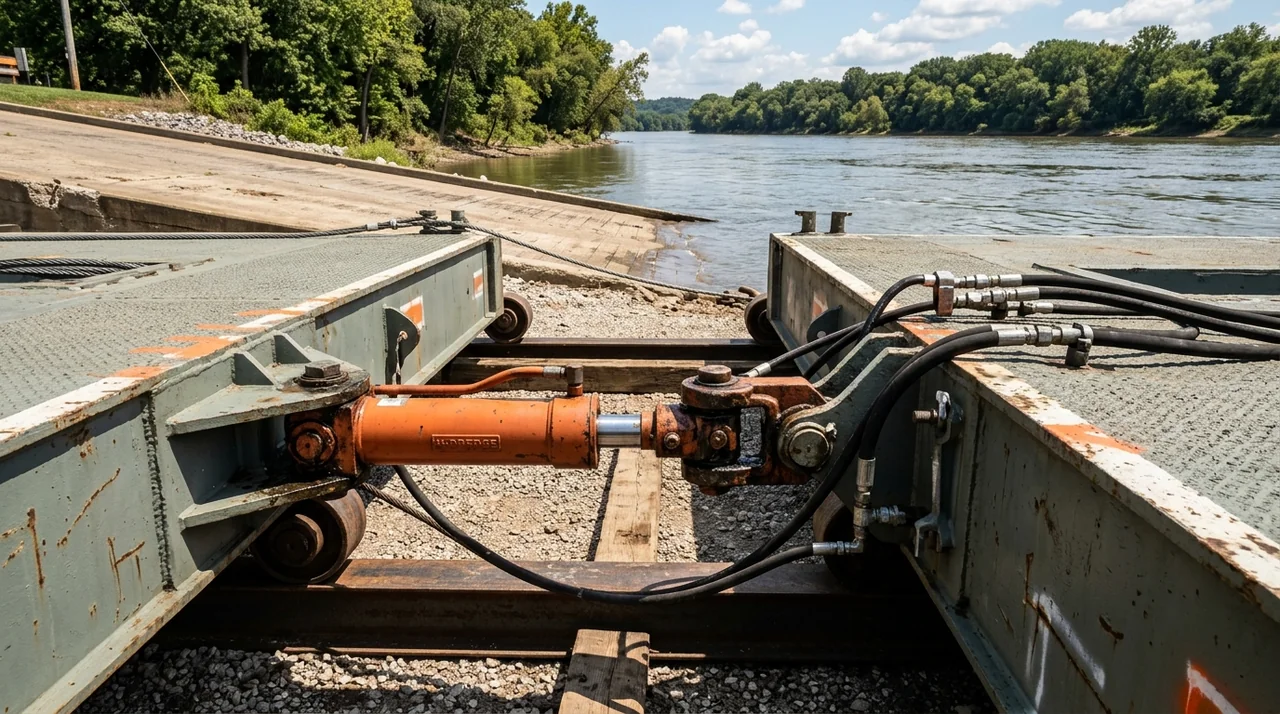
Field detail from a recent Work Marine project.
Sectional Barge Configuration Options for Bridge Repair
| Configuration | Deck Size (Approx) | Best For | Notes |
|---|---|---|---|
| Compact platform | 30 ft x 20 ft | Small pier repair | Highly mobile |
| Standard bridge deck | 40 ft x 24 ft | Most bridge projects | 10-ton crane friendly |
| Extended deck | 60 ft x 32 ft | Deck replacement | Longer approach |
| Custom configuration | Sized to project | Complex sites | Engineered per project |
Mobilization and Demobilization Timeline
A Work Marine sectional barge is designed to be truckable. Each module folds or nests to a legal-width road transport dimension in most states without escort vehicles, and the platform launches from any suitable boat ramp. In practice this means a barge can be on-site and operational within one to three days of the transport dispatch, even for projects six or eight states from the New Waterford, Ohio manufacturing hub.
Demobilization is symmetric. When the last pier repair is inspected and signed off, the crew breaks the barge down, loads the modules back onto the trailer, and either moves to the next site or returns the barge to the fabrication yard. Contractors who used to burn two weeks on each end of a bridge project setup and teardown are now hitting the water in days.
Engineering, Licensing, and Documentation
Every Work Marine platform is engineered by a team holding professional engineering licenses in multiple states, including Ohio, Pennsylvania, Colorado, and Texas. The company also holds ISO 9001, AISC, ASME, AWS, and National Board certifications, and every barge is designed to meet USCG Subchapter I regulations. That paperwork is what state DOTs and prime contractors ask for before a barge starts on a federally funded bridge project.
Key points to remember
The documentation packet includes stamped drawings, load charts, materials certifications, and inspection records. Work Marine provides all of this at delivery, and the engineering team is available by phone during a project to answer any question that comes up in the field. That level of support is what separates a real marine manufacturer from a fabricator who cuts steel and hands over the keys.
Talk to a Work Marine Engineer About Your Bridge Project
American-built barges shipped nationwide from New Waterford, Ohio. Licensed engineers on staff.
Frequently asked questions
How quickly can Work Marine mobilize a sectional barge to a bridge site?
Typical mobilization is one to three days from dispatch to launch, depending on distance from our Ohio facility. Emergency projects can move faster with pre-configured units.
Can I rent a sectional barge for a single bridge project?
Yes. Work Marine leases both mobile crane barges and sectional platforms for single projects with full engineering support included.
Are your barges USCG compliant?
Yes. Every Work Marine platform is engineered to meet USCG Subchapter I regulations, and we provide the stamped documentation prime contractors and state DOTs require.
Which states do your engineers hold PE licenses in?
Currently Colorado, New York, Ohio, Oklahoma, Pennsylvania, Texas, Utah, Virginia, West Virginia, and Wisconsin. Additional stamping available on request.
Can the barge hold a 10-ton crane while spudded down?
Yes. The standard 40 by 24 foot deck is engineered for a 10-ton crane on outriggers with proper spud placement. Larger crane picks require larger configurations.
Do you provide setup and training on site?
Yes on request. Our engineering team can be on site for launch, initial setup, and crew training on the Quick Connect attachment system.
Written by the team at Work Marine. Serving Nationwide (United States); New Waterford, Ohio (Manufacturing HQ).
Questions? Call (866) 883-4804 or visit workmarine.com.